I spent the last two weeks cleaning out my kids’ closets and under their beds and sorting through their dressers. (Yes, it took me two whole weeks.) Here’s the result:
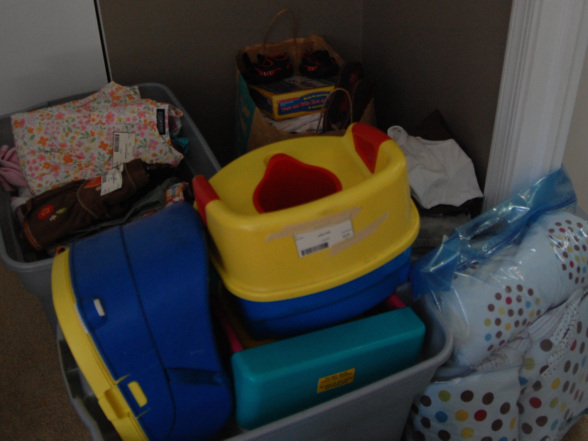
I had three boxes of things to sell on consignment and four bags of kids’ clothes to donate! Go, Mama!
There are so many great organizations where you can donate clothing: Goodwill, Salvation Army, Dress For Success and Purple Heart. And when you donate there, you can deduct clothing donations on your taxes! (Disclosure: I AM NOT A TAX EXPERT! These are just the resources I’ve found on my own.)
1) Make A Detailed Record Of Your Donated Items.
The IRS requires donors to value their items in order to claim the deduction. How do you figure out exactly how much you can deduct on your taxes? Fair market value is not the original purchase cost but the second hand used price. How do you figure that out? Check out Goodwill’s Donation Valuation Guide:

I know it takes a bit of time and you just want to drop that stuff out and get it out of your house. But just take 15 minutes, create an Excel spreadsheet and write down everything you’re donating. You will be AMAZED how quickly it adds up!
Some people also recommend taking digital photographs of each item, but I also usually just snap a quick picture of the bags of clothing I’m donating, just in case I need to prove how much I donated! Maybe take photos of high value items. I file this all in my ‘finances’ file on my computer for tax time. (I believe you are limited to $500 worth of clothing. If you have more than $500 worth of clothing or other goods to charities, you must complete Section A of Form 8283 Non Cash Charitable Contributions, and include it with your federal tax return.)
For more guidance, check out official IRS publications:
- Publication 561, Determining the Value of Donated Property – Useful if you want to examine a few valuation scenarios.
- Publication 526, Charitable Contributions – Addresses the entire subject of charitable donations and provides a useful background.
2) Get a Receipt.
While you are not technically obligated to obtain a written receipt from the charity if the total value of the donated clothing is under $250, you should still always request one for record keeping purposes. Sometimes, but not always, they’ll make a note on the receipt for you about exactly what was dropped off, but the description is usually very general, such as “3 bags of clothing”. At my Goodwill, they simply hand me a blank receipt so I usually just fill it out myself.
3) Don’t Forget to Claim the Value Of Your Clothing Donation As A Charitable Deduction On Your Tax Return!
This is so obvious, but this it totally something I would do. You went through all that trouble – so don’t forget to claim it! To claim the charitable tax deduction, you will need to report the value of your donated clothes on Schedule A of Form 1040 as an itemized deduction.
P.S. Another great deduction for clothes: Consignment Sales!
Twice a year, I sell my kids’ clothes in a consignment sale that benefits a non-profit organization. It’s a bit more work than just donating to Goodwill, but really pays off! This past sale, I sold around $300 worth of items, 30% of which was donated to the organization. So for a few days of work (sorting clothing, tagging items, etc.) I ended up with a receipt from the organization acknowledging my donation of $90 (which I can deduct on my taxes) and I walked away with $210 in cash! Now, not all sales benefit a non-profit, so you’d need to check into that for your consignment store. But if you can find one that benefits a church, school or hospital, go for it! It’s a great way to earn some cash for your items and get a tax deduction to boot!


 About Melissa
I think what you said is so right, this article is useful to me,I always forgot to leave commenting on other blogs and replying to my own. Good thing Authentic Soccer Jerseys my brain cell kicked in after that bowl of oatmeal .